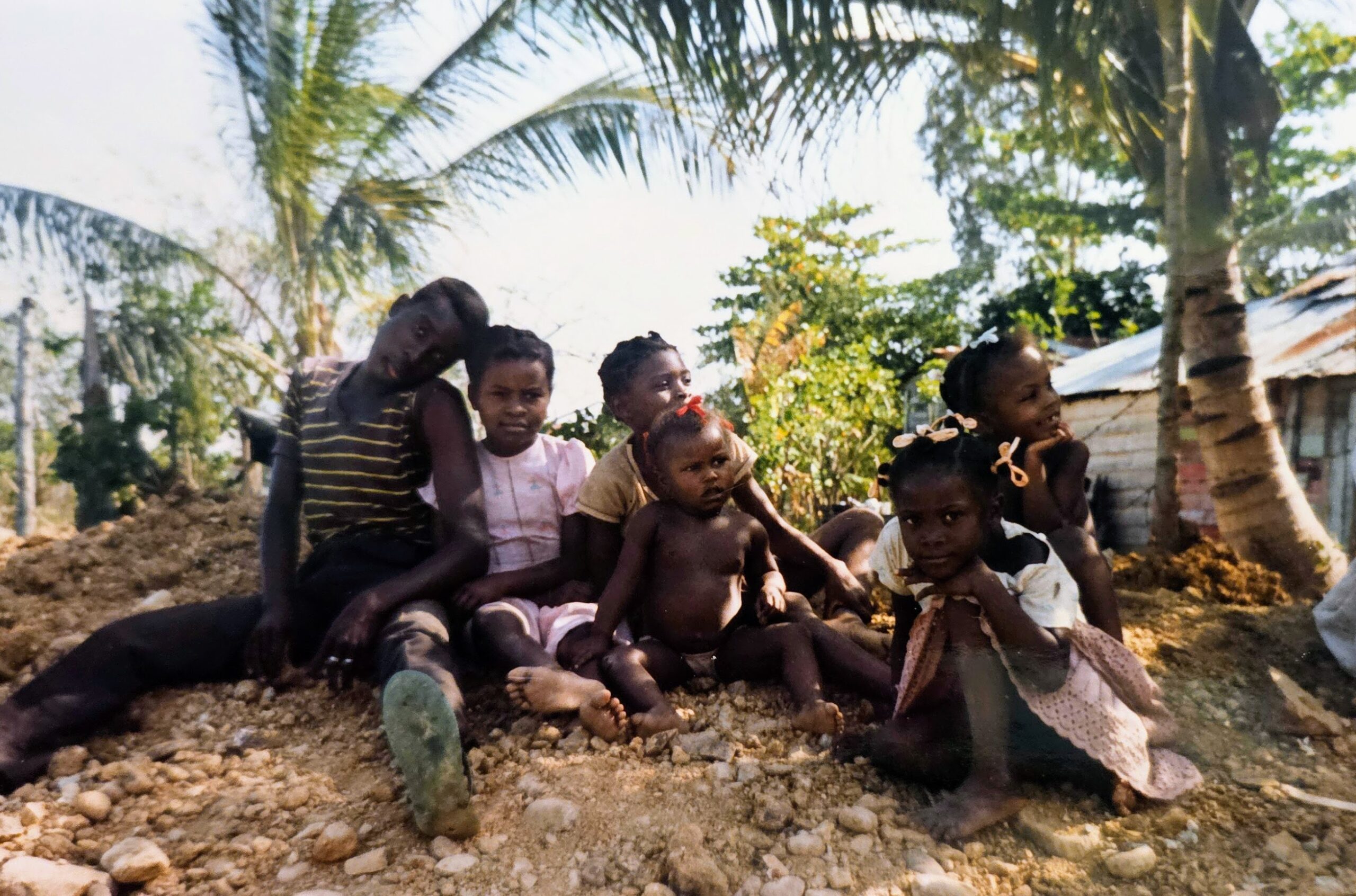
I was eighteen years old when I traveled to the Dominican Republic on a mission trip. The village was called Cabellona—or at least that is how I spelled it in my photo album. It was a village of poor Haitians who worked in the sugar cane fields. My photographs brought it all rushing back. There was Mylar, Santana’s son, who worked alongside us. There was Rudy Abreau, whose father owned a small store. There were pictures of Ruth and Rebekka laughing with village boys who proudly wore my sunglasses and grinned for the camera.
In a village where urine ran in a trench through the street, I have photos of the “banyo” we built near Johnny’s house. I have a snapshot of a small shack where seventeen people lived. I have a photo of a young girl with her belly swollen from malnutrition.
And there we were—a bunch of teenagers from Michigan—hauling rocks, carrying water, mixing cement, building pit toilets, working on a school, singing in churches, playing baseball with children, and giving them lots of piggyback rides.
The poverty was painful and profound. One of our adult leaders was taking construction notes with a stubby little pencil only a couple inches long. The lead broke. Annoyed, he tossed the pencil onto a nearby trash heap. What happened next stunned me. Several village children immediately raced for the pencil. Not a new pencil. Not a package of pencils with pristine erasers. A broken pencil. One little boy reached that stubby pencil first. I can still see him standing there, cradling that broken pencil stub like a priceless treasure. Because in a place with no toys and few school supplies, that is exactly what it was.
A few days later, our mission team headed home. After landing at O’Hare, we stopped at the Wendy’s spanning Interstate 294 in the Hinsdale Oasis. I ordered a hamburger, and I cried over it. I felt guilty for eating a whole hamburger by myself. Just a day earlier I had walked through a village where children went hungry. I had seen families surviving with almost nothing and I had played with kids who had never owned a pair of shoes.
Today I am a grandmother. The boys who borrowed my sunglasses are fathers and grandfathers themselves. They may even be married to the little girl with the swollen belly. The children who played baseball with us are now playing baseball with children and grandchildren of their own. A lot has changed. But one thing has not. They are still God’s children.
Because many of the people crossing our borders today come from poor villages just like Cabellona. They are not threats, burdens, invaders, or problems to be solved. They are Mylar and Rudy, Rebekka and Ruth. They are not headlines and hashtags. They are people. They are mothers and fathers. Children and grandparents. Workers and worshippers.
When I was eighteen years old, my church taught me to love being with the people of Cabellona. We prayed with them. We sang with them. We worked beside them. We sweated with them. We laughed with them. We called them our brothers and sisters. We treated each other as one family of God.
But today, somewhere along the way, many Christians seem to have forgotten those lessons. When these people lived in Cabellona, we sent them love-filled mission teams. But when those same people show up at our borders, we call them criminals and demand that they be deported. When they lived far away, we collected offerings. But when they want to live next door, we collect grievances. When they were strangers in another country, we called them neighbors. But today we are calling them enemies and blaming them for long-standing systemic problems in the United States.
What changed? Not the people. Not the image of God within them. The only thing that changed was their distance from us.
Today, too often from pulpits, podcasts, screens, and social media feeds, we hear fear instead of fellowship. We exude scorn instead of solidarity. We are filled with contempt instead of compassion. We want walls instead of welcomes. We have forgotten that the people who live in desperate poverty beyond our borders were our neighbors then, and they are still our neighbors now.
Years ago, we crossed a border to serve a little village of Haitian immigrants living in the Dominican Republic. We crossed that border to serve Santana and Mylar, Rudy, Ruth, and Rebekka. Because we knew they were beloved children of God. Because we could see Christ in their brown faces.
Today, faces like theirs are showing up at our borders, and yet we refuse to find them space in our photo albums.
What has happened to us?
Because if we could see Christ in the face of a Haitian child in Cabellona but cannot see Christ in the face of a Haitian immigrant today, then the border that most needs crossing is not between nations. It is within us.